



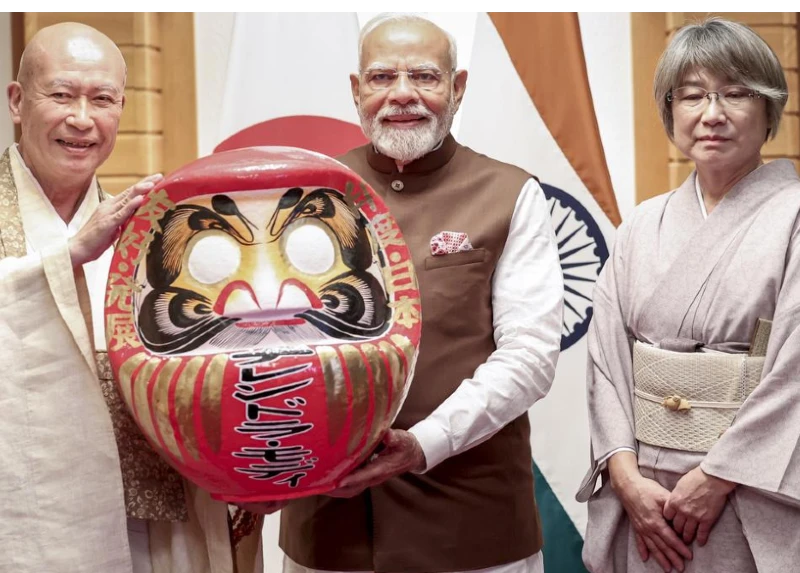
PM Modi is on his two-day visit to Japan, and in a special gesture, the Shorinzan Daruma-Jo temple priest, Rev Seishi Hirose, presented him a Daruma doll. While the doll holds significance in Japanese culture, it is also rooted in Indian culture. The doll is special because of its looks and has no limbs. It is connected with Bodhidharma, who was an Indian monk from Kancheepuram called Daruma Daishi in Japan. Bodhidharma is believed to have meditated for 9 years with his eyes closed and limbs folded.
This is cited as the reason for the round shape of the doll with no limbs or eyes. The other reason for the shape of the doll is often cited in its connection with Zen Buddhism, founded by Bodhidharma. It is said that the doll signifies the principles of Zen Buddhism, showing the importance of perseverance and the setting and achievement of goals. Its round shape and flat bottom also allow it to tip over when punched down, highlighting its importance in never giving up in life.
People often use the doll to set goals. After setting a goal, one eye of the doll is painted, and the other eye is painted after achieving it. They are popular across Japan, and are not just an integral part of their festivals but daily life. They are used for professional growth, disciplines, and prosperity in life.
The Prime Minister also met the former Prime Minister and the current Chairman of the Japan-India Association, PM Yoshihide Suga, and Fumio Kishida. PM Modi posted on X, about the meeting listing the important discussions between them, including AI, technology, investments and trade relations, and talks for deepening ties between India and Japan. About his meeting with Kishida, he further added that new opportunities to collaborate, like technology and semiconductors, have been discussed as the partnership is significant in the current world scenario and the high tariffs imposed on India by the US.