


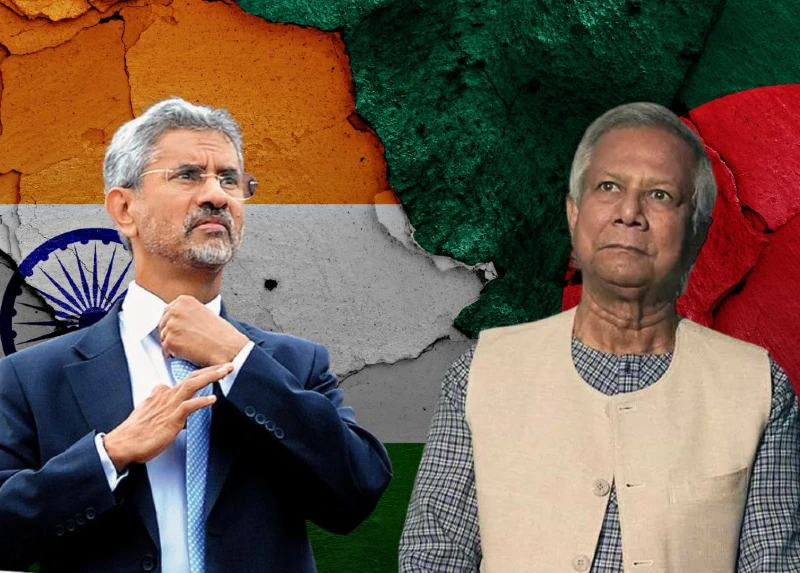
The relations between India and Bangladesh have become more complicated and sensitive than ever. In a recent development, a radical Bangladeshi group announced a march to the Indian High Commission on Wednesday, to allegedly protest against India’s interference in the politics of Bangladesh.
Soon after the announcement was made, the External Ministry of India summoned the Bangladeshi High Commissioner to India, Riaz Hamidullah, and reportedly reminded him about his duties to protect India’s embassy and visa facilities in Bangladesh. The MEA, after meeting Mr Hamidullah, stated that India rejected the claims made by the radical groups in Bangladesh. The statement further said that it was unfortunate that the interim government in the country had not investigated the matter and kept India out of the loop, even as the matter escalated.
The July Oikyo Mancho, which includes several conservative parties and organisations, called for a march at 3 pm on the Indian High Commission from Rampura Bridge in Dhaka. The demands of the group were regarding the ousted Prime Minister of Bangladesh, Sheikh Hasina, who is in India after she fled from the country earlier. The group asked for her return, and also called to stop India’s alleged interference through proxy parties in the country’s politics and domestic affairs.
As the announcement came out, the Indian Visa Application Centre in Dhaka stopped all work from 2 pm, rescheduling all appointments for the second half of the day. The group began its protests and reached halfway towards the Commission, but was stopped by the police. Rashed Pradhan, the Leader of Jatiyo Gonotantrik Party, stated that the next time they would march inside the High Commission. He added that the authorities in Bangladesh thought they needed “Hindustan’s” support to exit, but the protest on 5th August 2024 showed that it was not the case.
MEA’s remarks came a day after both countries celebrated the Vijay Divas, marking the end of the Bangladeshi Liberation War of 1971. Tensions escalate, as anti-Indian remarks have become more evident from the Bangladeshi officials. In one instance, Hasnat Abdullah, the Leader of the National Citizens’ Party, called India a hostile country and also threatened to strain India’s contact with its North-East region.