

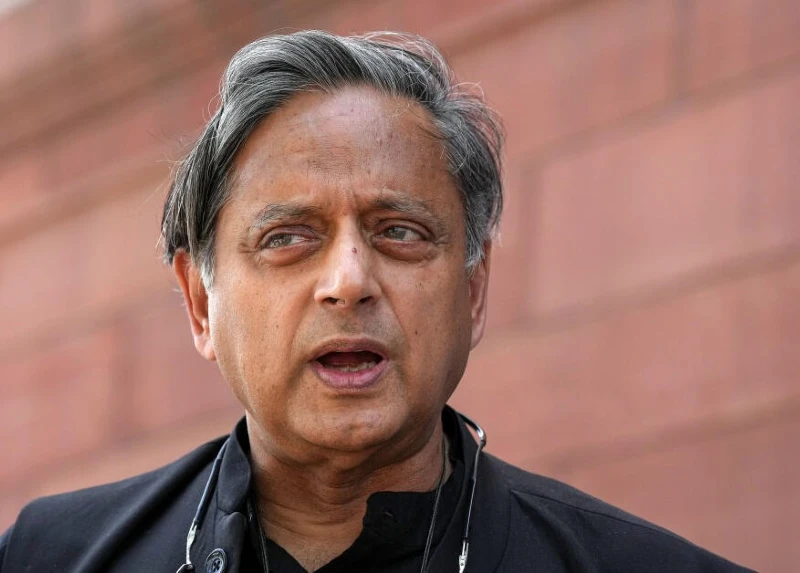
The problem of dynastic politics in India is not new. Speaking on the issue, Senior Congress leader Shashi Tharoor stated that it was a “threat to democracy”. He emphasised that when political power is not based on merit and ability, but on lineage, the governance of the country suffers.
In an article written for the international media organisation Project Syndicate, the Parliamentarian pointed out that though the Gandhi-Nehru nexus is strong and evident, dynasties exist across the political spectrum. BJP leaders have supported Tharoor’s article, calling it an “insightful piece”. Shehzad Poonawalla, the BJP Spokesperson, said that Tharoor has launched an attack on Rahul Gandhi and Tejashwi Yadav.
Tharoor’s article comes out after his previous stance during the Pahalgam attack, favouring the ruling party, and his diplomatic outreach during the aftermath of the attack. The earlier remarks have also garnered a lot of criticism from the Congress party. The article is titled ‘Indian politics is a family business’, where Tharoor explains how Indian politics has been overshadowed by one family.
In the article, he mentions the former Prime Ministers starting from Jawaharlal Nehru, Indira Gandhi, Rajiv Gandhi, and the present opposition leaders, Rahul Gandhi and Priyanka Gandhi Vadra. He also pointed out that Indian politics is largely driven by personality, leaving some exceptions. Talking about the lack of democracy within the party structures, he highlighted that nominations to the leadership positions are not transparent and are often made by a small group or sometimes even one leader.
Tharoor himself is known to have contested for the party presidency in 2022. He also said that dynastic politics is visible across the party spectrum, as was seen in the case of Biju Patnaik and his son Naveen Patnaik. When the former died, the latter was given his seat in the Lower House of the parliament.
The same is visible in the case of Maharashtra, where Bal Thackeray passed the baton to his son Uddhav Thackeray, and now his son Aditya is waiting to succeed, he added. Emphasising that these examples show that meritocracy is not considered in the face of nepotism.
He also pointed out the political families in India’s heartland and its most populous state, UP. Going all the way to the North, a similar trend is visible where the Abdullahs have been in power for three generations, and the opposition itself is headed by Muftis. The article by Mr Tharoor also examines the intricacies of family ties at the grassroots levels. He claims that the issue of nepotism is not just visible in a few parties at the national level but can be seen on the grassroots level as well.
He also emphasised a similar trend seen in the Indian subcontinent, including our neighbours, Bangladesh, Nepal, and Pakistan.