

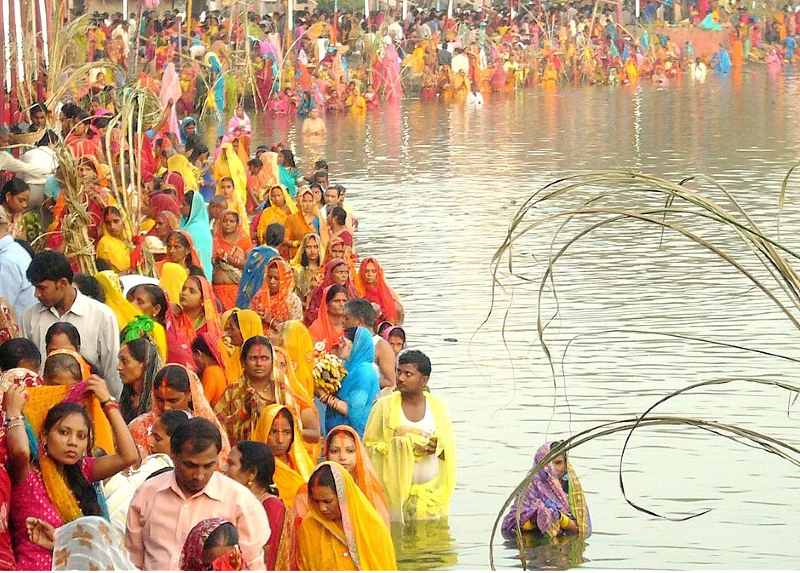
Devotees across the country have completed the final offering to the Sun god on 28th October, marking the last day of the four-day Chatt Pooja festival. Bihar saw the highest number of devotees offering the ‘Usha Arghya’.
Chatt Pooja is Bihar’s largest festival, where devotees gather around ghats of the River Ganga and other water bodies to celebrate the setting and rising sun. As per Patna’s district administration, arrangements across 100 ghats were made to avoid any accident during the festivities. The Chief Minister of Bihar, Nitish Kumar, also participated in the pooja at his official residence along with family members.
Chatt Pooja is a four-day festival that starts on the sixth day of Diwali during ‘Kartik Shukla’. This year, it started on 25th October with the ‘Nahai Khai’ ritual, where the person observing the fast takes a dip in the sacred pond or river and eats only one meal after the ritual. The water from the pond is also brought home to make a chulha, and the devotee eats food cooked on this chulha for the rest of the days. The meal consists of a pumpkin or Bottleguard sabzi and rice.
On the second day, which is ‘Kharna’, the devotee observing the fast takes only one meal in the evening, which consists of roti and kheer. After the rituals, the preparation of thekua, which is the main prasad offered to God, is prepared. Friends and members of the family sit together to prepare the Prasad.
The roti-kheer meal is the last meal, after which the devotees observe a 36-hour fast without food and water. During the next day, the ‘Pratyusha Arghaya’ is performed in the evening when the person stands in a waterbody and prays to the Sun god. At the dawn of the next day, the final Arghaya is performed, marking the culmination of the festival.
Chatt Pooja is a significant festival, as it signifies nature’s worship. No priest or idol is worshipped during the four days, but a direct connection with the visible god, that is, the Sun, is worshipped. Chatti Maiyya, who is regarded as the sister of the sun god, is worshipped as the deity, and it is said that the festival dates back to the early Vedic times.
A parallel is also found in the Ramayana, and Mahabharata. In Ramayana, Lord Rama and his Consort Seeta Mata are recorded to have worshipped the Sun god after returning to Ayodhya. While in Mahabharata, Draupadi observed a fast to worship Sun god, after which her prayers were answered.
The Pooja is clear to Purvanchali’s heart, and above all, is a symbol of hope in life. It upholds that what is set will always rise.