


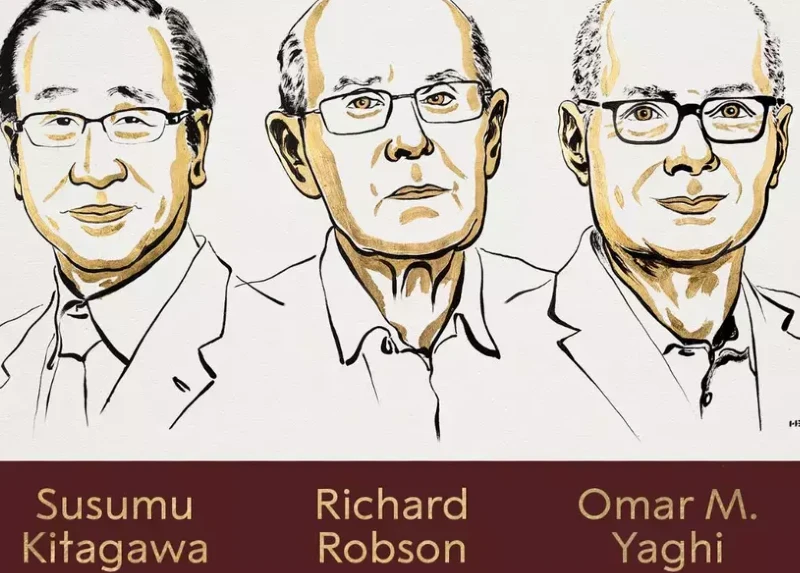
The 2025 Nobel Prize in Chemistry has been awarded to Susumu Kitagawa, Richard Robson, and Omar M Yaghi for their breakthrough innovation of metal-organic frameworks. The three scientists belong to universities in Kyoto, Melbourne, and Berkeley, respectively.
The Royal Swedish Academy of Sciences issued a statement explaining that the trio has successfully made molecular constructions that have large spaces through which gases can easily pass. This has multiple uses, such as capturing carbon dioxide, harvesting water from desert air, storing toxic gases, and even breaking down pharmaceutical traces in nature.
Heiner Linke, the chairman of the Nobel Committee for Chemistry, said that the metal-organic framework has enormous potential as it opens up previously unknown opportunities and several new functions of customised elements. Olof Ramstrom, who is a member of the Committee, said that this innovation can be compared with Hermione Granger’s handbag, from Harry Potter, as it is small from the outside but is extremely large inside.
Kitagawa, speaking at a conference, stated that he dreamt of capturing and separating air into different components and using it to generate renewable energy to power the future. He also expressed his gratitude for the recognition. Yaghi, who was born to Palestinian refugees, said that his journey from a small house in Jordan described his journey, stating that it is only science that allows you to do that. In the interview published on the Nobel Website, he told how his parents could neither write nor read, but science opened this path for him.
Talking about his life, he shared how he first came across molecules in a book when he was just 10 years old, and that started his lifelong love for molecules. The three scientists have been working separately on the experiment, but complemented each other to build the metal framework similar to the timber framework of a house.