


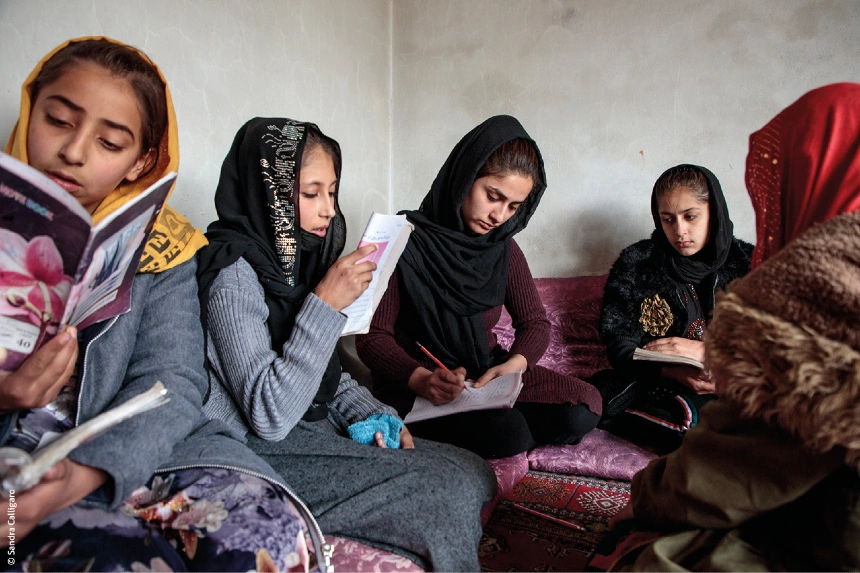
Ever since the Taliban took control over Afghanistan, the beautiful mountain country has seen unprecedented restrictions, especially on the women of the country. As of 2025, it has been four years since the girls and women in the country were not able to attend school after the age of 12.
According to the reports of UNICEF the restrictions in Afghanistan have affected over 1 million girls. Initially, the Taliban authorities claimed that the ban was temporary and progress would be made once the “Islamic” curriculum is adopted in institutions, however despite the adoption of the curriculum nothing has been done and girls above the age of 12 still wait to access education in the Asian nation.
Few who can afford education have the only option to go to Madarssaas to study, but most of the curriculum here is religious and made to promote the Taliban’s ideology, as per the reports of the Afghanistan Centre for Human Rights. The report also suggests that “extremist content” is a part of the curriculum. The state of affairs in Afghanistan is disturbing and it is only deteriorating with time. The World Happiness Report consistently ranks it as the most unhappy country in the world year after year depicting its social situation.
The Afghanistan Centre for Human Rights has called this ban a “systematic and targeted violation” of the right to education of women. The Madrassas still offer the only respite from the condition and it has been reported that most of them have also tried incorporating more subjects like chemistry, physics, and maths.
Apart from this deliberate ban, UNICEF reports that education at primary levels has also dropped to only 1.1 million fewer boys and girls going to school. Amidst its strict policies against women, the leaders of the country are sabotaging the future potential of the nation. With the impact of it visible in social, developmental, and economic spheres.
It will not only lead to an impoverished society that lacks women doctors, teachers, and professionals but is also impacting the state of the mental and emotional well-being of women. It has also been reported that the girls who have lost major years of life away from schooling have not been able to recover in future and this impacts younger kids for generations to come.
UNESCO among other organisations have provided alternatives to education, but it’s the moral responsibility of the Taliban authorities to remove the ban as soon as possible and bestow the right to education on the women of the country.